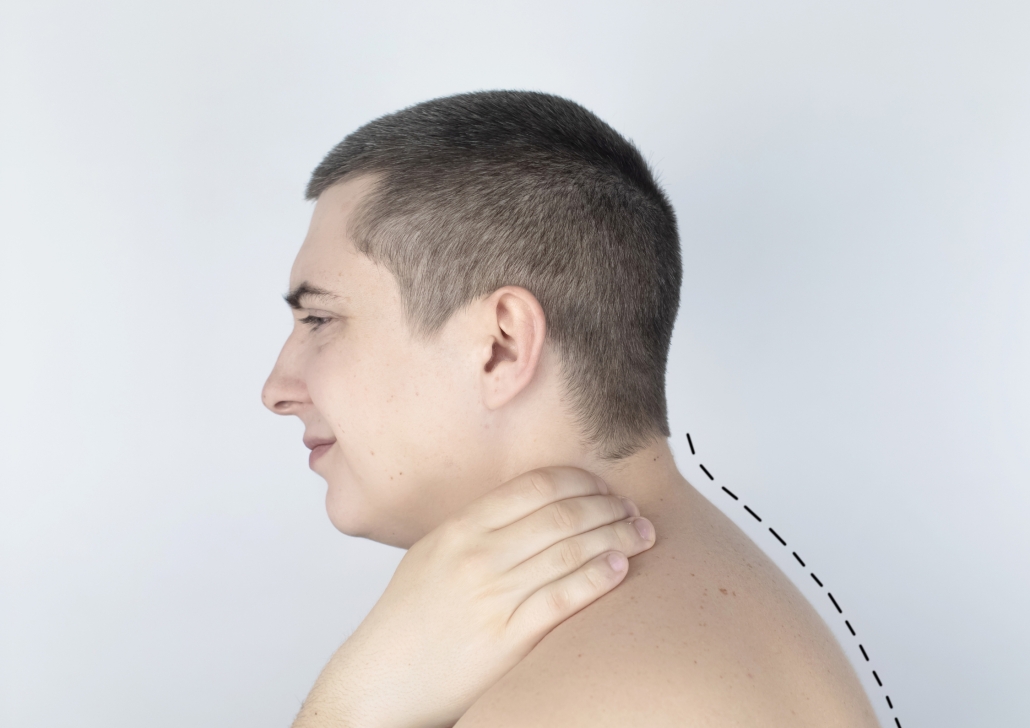
The severity of kyphosis is assessed by measuring the forward curvature of the spine in the thoracic region on radiographic images. Everyone has a natural kyphotic curve in the thoracic region. However, an excessive increase in this curvature may constitute a condition that requires evaluation in conjunction with postural abnormalities, pain, changes in spinal balance, or impacts on daily life.
The degree of kyphosis alone is not sufficient to determine a diagnosis or treatment decision. The patient’s age, growth status, whether the curvature is structural, pain, risk of progression, spinal balance, and overall health are all considered together.
What Is the Degree of Kyphosis?
The degree of kyphosis refers to the measurement, in degrees, of the curvature in the thoracic region as seen on a lateral X-ray of the spine. This measurement helps determine whether the curvature falls within normal limits or exceeds them.
A certain degree of kyphotic curvature in the thoracic spine is normal. The AAOS states that thoracic kyphosis of approximately 20–45 degrees can be considered normal. Curvatures exceeding 50 degrees, however, may be classified as excessive kyphosis or hyperkyphosis.
| Kyphosis Angle | Overall Assessment | Not |
|---|---|---|
| Approximately 20–45 degrees | Normal range of thoracic kyphosis | It is evaluated in conjunction with clinical findings |
| Above 50 degrees | It is evaluated for increased kyphosis / hyperkyphosis | Posture, pain, and spinal alignment are important |
| Progressive curvature | Closer monitoring may be necessary | Compared with previous measurements |
| If accompanied by pain or loss of function | A detailed assessment is required | It may be clinically significant regardless of the degree |
How Is the Degree of Kyphosis Measured?
The degree of kyphosis is typically assessed using X-rays of the spine taken while the patient is standing. During the measurement, the angle of curvature in the thoracic region of the spine is calculated. The physician interprets this measurement in conjunction with the patient’s posture, physical examination findings, and symptoms.
The degree of the condition determined by the measurement is important; however, it is not always sufficient on its own. For example, of two patients with the same degree of the condition, one may be pain-free and well-balanced, while the other may experience pain, postural abnormalities, or difficulties in daily life.
What Does Mild Kyphosis Mean?
"Mild kyphosis" is a general term used to describe conditions in which the curvature is close to the natural curve or shows only a slight increase. In some patients, this condition may be associated with postural abnormalities, prolonged forward-leaning posture, muscle imbalances, or postural habits developed during the growth period.
Active treatment is not always necessary for mild kyphosis. Depending on the clinical evaluation, options such as monitoring, exercise, posture awareness, and approaches that support muscle balance may be considered.
| Situation | Evaluation |
|---|---|
| If there is no pain | Regular follow-up and posture assessment may be sufficient |
| If accompanied by poor posture | Exercise and posture awareness can be assessed |
| If the patient is a child or adolescent | The growth process is monitored |
| If the curvature is increasing | Radiological follow-up and medical evaluation are important |
How Is Moderate Kyphosis Assessed?
In cases of moderate kyphosis, the degree of curvature, the presence of pain, spinal balance, and whether the curvature has increased over time are evaluated together. Especially in children and adolescents who are still growing, follow-up becomes even more important in terms of the risk of the curvature progressing.
In this group, exercise, physical therapy, posture training, and, in some patients, evaluation for a brace may be considered. However, the decision to prescribe a brace is not based solely on the degree of curvature; growth potential, the nature of the curvature, and clinical findings are also taken into account.
What Does Advanced Kyphosis Mean?
"Advanced kyphosis" is a general term used to describe a significant increase in the curvature of the spine that, in some patients, affects posture, causes pain, limits mobility, or impacts daily life.
Johns Hopkins defines kyphosis as a spinal curvature of 50 degrees or more; it also notes that for children who are still growing, options such as a brace may be considered at higher degrees of curvature. However, the decision for each patient is made based on an individual clinical evaluation.
In cases of severe kyphosis, the following conditions may require a more detailed evaluation:
| Case Under Review | Why Is It Important? |
|---|---|
| A high degree of curvature | Spinal alignment and posture may be affected |
| Pain | It may affect daily life |
| Progression of the curvature | The treatment plan may change |
| Neurological symptoms | A neurological evaluation may be necessary |
| Respiratory involvement | In cases of severe curvature, the structure of the rib cage can be evaluated |
| Balance disorders in adult patients | Walking and mobility may be affected |
What Does a 50-Degree Kyphosis Mean?
A 50-degree kyphosis may indicate that the curvature in the back region exceeds normal physiological limits. The Cleveland Clinic also notes that a curvature of more than 50 degrees can be considered a significant threshold in the diagnosis of kyphosis.
However, a measurement of 50 degrees alone does not necessarily mean that treatment is required. The patient’s age, symptoms, whether the curvature is structural, whether it has increased compared to previous measurements, and its impact on daily life are all evaluated together.
What Does a 70-Degree Kyphosis Mean?
A 70-degree kyphosis may indicate a more pronounced degree of curvature and typically requires a more detailed orthopedic evaluation in most patients. In cases of curvature at this level, pain, postural abnormalities, limited mobility, functional impairment independent of aesthetic appearance, or the risk of progression may be assessed.
In such cases, the treatment approach varies depending on the patient. While non-surgical methods may be used for some patients, surgical evaluation may be considered for others. The decision is based not only on the severity of the condition but also on the patient’s overall clinical presentation.
Does the Degree of Kyphosis Alone Determine the Treatment Decision?
No. The degree of kyphosis is an important factor; however, it does not determine the treatment decision on its own. The following factors are considered together during the clinical evaluation:
| Factor | Its Role in the Treatment Plan |
|---|---|
| Age | The assessment process differs for children, adolescents, and adults |
| Growth Status | If growth continues, the risk of progress may change |
| Degree of curvature | It affects monitoring and treatment options |
| Rate of curvature progression | Compared to previous graphs |
| Pain | It is clinically significant |
| Spinal Balance | It is evaluated in terms of posture and mobility |
| Neurological findings | An evaluation of the nervous system may be necessary |
| Impact on daily life | It is taken into account in the treatment plan |
The Difference Between Postural Kyphosis and Structural Kyphosis
One of the key distinctions in the assessment of kyphosis is whether the curvature is postural or structural in nature.
In postural kyphosis, postural habits, muscle weakness, or prolonged forward-leaning postures may play a role. In some patients, the appearance may change significantly once posture is corrected.
In structural kyphosis, changes in the bone structure of the spine, spinal alignment, or the growth process may play a role. In this case, the curvature may not be fully corrected by posture alone, and a more detailed evaluation may be necessary.
| Kyphosis Type | General Features |
|---|---|
| Postural kyphosis | It may be related to posture habits |
| Scheuermann kyphosis | It may be associated with structural changes in the spine during the growth phase |
| Congenital kyphosis | It may be associated with congenital spinal abnormalities |
| Adult Kyphosis | It may be related to age, bone quality, or spinal degeneration |
Degree of Kyphosis in Children and Adolescents
Growth potential is important in the assessment of kyphosis in children and adolescents. The curvature may change as growth continues. For this reason, in children, not only the current degree of curvature is assessed, but also whether there has been an increase during follow-up visits.
In this age group, posture habits, school bag use, prolonged screen time, muscle balance, and the growth process can be considered together. However, not every instance of a hunched appearance indicates structural kyphosis.
Degree of Kyphosis in Adults
The assessment of kyphosis in adults differs from that in children. In adult patients, pain, lumbar-thoracic balance, bone quality, spinal degeneration, muscle strength, limited mobility, and the impact on daily life may be more pronounced.
In adults, the degree of kyphosis is not evaluated in isolation. The patient’s overall health, any accompanying spinal problems, pain level, and functional capacity are all taken into account.
When Should You Visit the Department of Orthopedics and Traumatology?
An evaluation by the Department of Orthopedics and Traumatology may be appropriate in the following situations:
| Situation | Why Should It Be Evaluated? |
|---|---|
| If there is a noticeable hump on the back | A distinction can be made between kyphosis and postural abnormalities |
| If pain is present | Any accompanying spinal problems can be evaluated |
| If the curvature increases over time | Monitoring may be necessary to assess the risk of progression |
| If the child is going through a period of rapid growth | Curvature may change during the growth process |
| If there is limited mobility | Functional impairment is assessed |
| If you have shortness of breath or a severe postural abnormality | In cases of severe curvature, a detailed evaluation may be necessary |
| If there are symptoms such as numbness or weakness | An evaluation based on neural structures is necessary |
Frequently Asked Questions (FAQ)
At what angle does kyphosis become a concern?
The degree of kyphosis alone is not sufficient. There is a certain degree of natural kyphotic curvature in the thoracic spine. Curvatures exceeding 50 degrees may be considered indicative of increased kyphosis; however, age, pain, progression, and spinal balance must be considered together.
Is a 50-degree kyphosis dangerous?
A 50-degree kyphosis does not mean the same thing for every patient. This degree of kyphosis may require evaluation; however, the decision regarding treatment is based on the patient’s age, symptoms, the nature of the curvature, and clinical findings.
What does a 70-degree kyphosis mean?
A 70-degree kyphosis may indicate a more pronounced degree of curvature. In this case, a detailed evaluation can be conducted regarding pain, postural abnormalities, spinal balance, the risk of progression, and the impact on daily life.
How is the degree of kyphosis measured?
The degree of kyphosis is typically measured using standing X-rays of the spine. This measurement allows for the assessment of the curvature of the spine in the back region as an angle.
Can mild kyphosis be corrected?
The prognosis for mild kyphosis depends on whether the curvature is postural or structural in nature. In cases of postural curvature, exercise and posture awareness can be helpful. In cases of structural curvature, follow-up and medical evaluation are important.
Does kyphosis require surgery?
Not every patient with kyphosis requires surgery. Surgical evaluation may be considered in cases of severe, progressive kyphosis that leads to pain, loss of function, or neurological symptoms. The decision is made on a case-by-case basis.
Are kyphosis and scoliosis the same thing?
No. Kyphosis is an increase in the forward curvature of the back. Scoliosis, on the other hand, is a lateral curvature of the spine. These are two different types of spinal curvature.
Information Note
This article is intended to provide general health information. It is not a substitute for diagnosis or treatment. The diagnosis, follow-up, treatment, or surgical evaluation plan for kyphosis is determined based on a physician’s examination, radiological evaluation, and the patient’s clinical condition.
Related Pages
- Kyphosis Treatment and Hunchback
- Is a hunched back just an aesthetic problem?
- Guide to Spinal Curvature
- Contact Information
Bibliography
In preparing this content, patient education resources on kyphosis grades, hyperkyphosis, the normal range of thoracic kyphosis, and the assessment of kyphosis in children and adults were consulted.