
How to Recognise Scoliosis in Children: An Early Diagnosis Guide for Families
Scoliosis (spinal curvature), one of the most common spinal deformities, is a structural problem that is particularly seen in children during their growth phase and can be progressive in nature. As Prof. Dr. Çağatay Öztürk, we frequently emphasise in our spinal surgery practice that the key to successful scoliosis management is detecting the deformity before it reaches surgical limits.
In this article, we will discuss how parents should interpret changes in their children's posture and examine the medical symptoms of scoliosis in light of current literature.
The Medical Difference Between Postural Deformity and Scoliosis
Two concepts that are often confused by parents are "postural disorder" and "scoliosis". Medically, the distinction between these two conditions is clear:
- Functional Postural Disorders: It is usually due to muscle weakness, habits or psychological factors. When alerted, the child can straighten their spine.
- Structural Scoliosis: It is a condition where the spine bends more than 10 degrees to the side and simultaneously rotates around its own axis. This is an anatomical deformity and cannot be corrected by the child's voluntary movement.
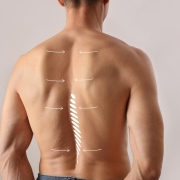
Scoliosis may appear to be a simple posture disorder when viewed from the outside; however, the underlying rotational movement causes asymmetries in the rib cage and back.
The 5 Key Physical Symptoms of Scoliosis
The type we refer to as Adolescent Idiopathic Scoliosis (AIS), which occurs between the ages of 10 and 18, is generally painless. Therefore, monitoring physical findings is of vital importance. The key asymmetries parents should look out for when observing their children are as follows:
- Shoulder Level Difference: When the child looks across, one shoulder is positioned higher than the other.
- Scapula (Shoulder Blade) Prominence: When viewed from behind, one shoulder blade protruding or being more prominent than the other.
- Waist Curve Asymmetry: When the arms are relaxed at the sides of the body, the distance between the arm and the waist (waist triangle) is not equal on the right and left sides.
- Pelvic (Pelvic Bone) Imbalance: The appearance of the hip being shifted to one side or the feeling of unequal leg lengths (false shortness).
- Body Shift: The head not being directly above the centre of the pelvis, the torso leaning to the right or left.
Scoliosis Home Screening Method: Adam's Forward Bend Test
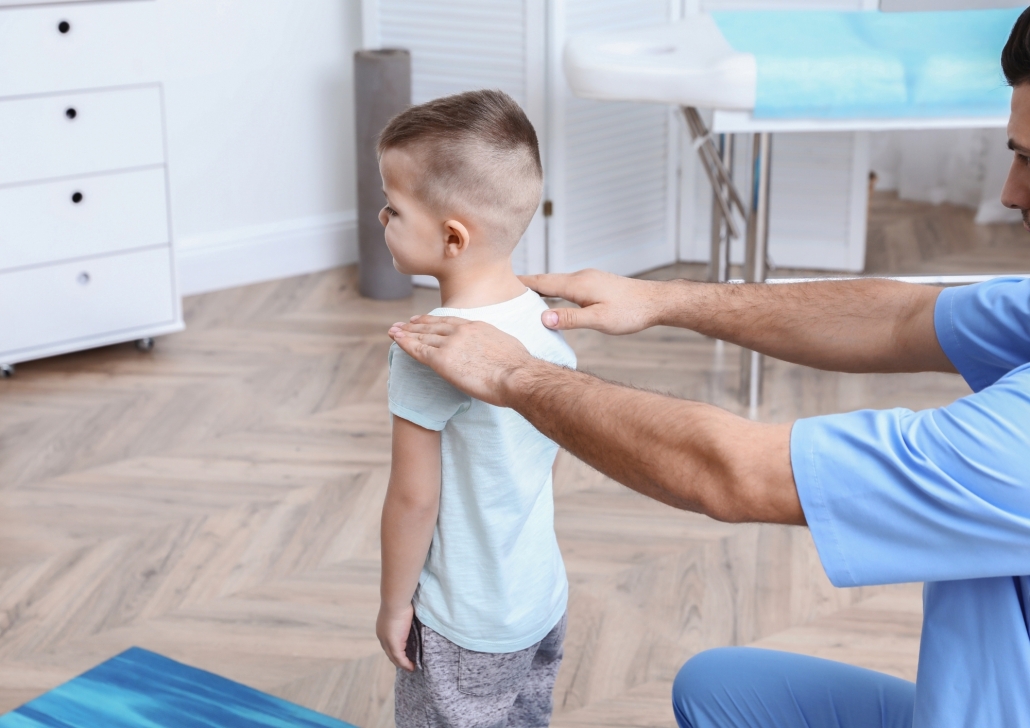
The Adam's Forward Bend Test, which we routinely perform during clinical examinations, can be used by families as a preliminary screening method at home.
Application: The child's feet are together, knees bent and legs stretched out in front. Arms are left hanging freely down. Evaluation: The parent should look at the child's back surface from behind. If a height or bump (rib hump) is noticed on one side of the spine (usually on the right back or left waist area) compared to the other side, this is a strong indicator of spinal rotation.
This finding, while not a definitive diagnosis, is the most important indicator that a spinal surgeon should be consulted for further examination and X-ray imaging.
Why is Early Diagnosis Important in Scoliosis?
The decisive factors in the treatment of scoliosis are the degree of curvature (Cobb angle) and the child's remaining growth potential (Risser stage). In a child whose growth plates are still open, low-grade curvatures can be controlled with brace treatment and specific exercises. However, in cases that are detected late and have progressed (over 45-50 degrees), surgical intervention may be necessary.
Scientific data indicates that conservative (non-surgical) methods have a higher success rate in cases of scoliosis detected at an early stage. Therefore, if any of the physical symptoms mentioned above are suspected, seeking expert advice is the most appropriate approach rather than adopting a "it will improve over time" attitude.
Frequently Asked Questions (FAQ)
Does scoliosis cause pain? Scoliosis during adolescence is largely painless. This can lead to the insidious progression of the disease. Pain is more commonly seen in degenerative scoliosis in adulthood or in cases of severe curvature. The absence of pain does not mean that scoliosis is not present.
Does carrying a heavy school bag cause scoliosis? In current medical literature, there is no evidence that carrying heavy bags directly causes structural scoliosis (curvature of the spine). However, heavy loads can lead to postural disorders and back pain. For spinal health, the weight of the bag should not exceed 10-15% of body weight.
Can children diagnosed with scoliosis participate in sports? Yes, people with scoliosis are encouraged to lead an active lifestyle. Swimming and exercises that strengthen the spinal muscles are beneficial for overall fitness. However, for professional-level sports and activities appropriate to the degree of curvature, you must consult your doctor.