Can Adults Develop Scoliosis? Daily Recommendations for Maintaining Spinal Health

Contrary to popular belief, scoliosis (curvature of the spine) is not a condition exclusive to children. Yes, scoliosis can also occur in adults, and its prevalence may even increase with age. However, the process in adults differs from that in children.

In this article, we will focus on what you need to change in your daily life to maintain your spinal health in adulthood and build resistance to potential curvatures.

What Causes Scoliosis in Adults?

There are generally two factors underlying the spinal problems we encounter in adulthood:

  1. The Legacy of Childhood: A very slight curvature that goes unnoticed during adolescence may become slightly more pronounced over the years due to the effects of gravity.
  2. Ageing Effect: Just as our faces wrinkle and our hair turns grey, our spine also ages. The loss of fluid in the discs between the vertebrae and the wear and tear of the joints can disrupt the balance of the spine, leading to "secondary" curvatures.

So, what can we do to slow down the progression of scoliosis in adults or keep our spine strong against this wear and tear?

5 Golden Tips for a Spine-Friendly Life

Before resorting to medical interventions, making small changes to your lifestyle is the most effective remedy for relieving the strain on your spine.

1. Strengthen your "natural corset"

Your spine is not a pillar that carries your body on its own; it is surrounded by muscles. The stronger your abdominal and back muscles are, the less load is placed on your spine (bones). We call this the body's "natural corset".

  • Suggestion: Do exercises that work the muscles around the spine at least 2-3 days a week, ensuring they are non-impact (do not require jumping). Swimming and Pilates are among the best spine-friendly sports.

2. Challenge Inactivity

The modern-day affliction of "inactivity" is the greatest enemy of spinal health. Sitting in the same position for long periods increases pressure on the discs.

  • Suggestion: If you work at a desk, be sure to stand up every 45 minutes, walk for 2 minutes or do some simple stretching exercises. Your spine needs movement to stay healthy.

3. Be Mindful of Technology Use: Scoliosis in Adults

Nowadays, we constantly bend our heads forward to look at our smartphones. Every centimetre the head bends forward increases the load on the neck and spine. Over time, this can lead to poor posture and hunching of the back (kyphosis).

  • Suggestion: Try to hold the phone at eye level, not at chest or stomach level. The top edge of your computer screen should be at eye level.

4. Weight Control is Important

Every extra pound on your body means extra weight for your spine to carry. Fat around your belly especially shifts your centre of gravity forward, putting pressure on the curve in your lower back (lordosis) and throwing your spine off balance.

  • Suggestion: Maintaining your ideal weight is vital not only for your heart health but also for your spinal mechanics.

5. Support Bone Quality

With age, a decrease in bone density (osteoporosis) can lead to compression fractures in the vertebrae and associated curvature. The harder and stronger your bones are, the straighter your spine will be.

  • Suggestion: Eat a balanced diet. Have your calcium and vitamin D levels monitored by your doctor. It is also a scientific fact that smoking impairs the nutrition of the discs, accelerating wear and tear; stay away from cigarettes for the sake of your spine.

When Should You Consult a Specialist?

Back pain is something everyone experiences from time to time. However, if the following situations apply, it is advisable to see a specialist rather than dismissing it as "old age" or "I caught a chill":

  • If the pain does not go away with rest and wakes you up at night,
  • If you notice a visible asymmetry (shift) in your back or waist,
  • If you feel the need to lean forward while walking,
  • If you notice a change in the fit of the clothes you wear.

Remember: the better you look after your spine, the longer and straighter it will carry you.


Frequently Asked Questions (FAQ)

Can postural problems in adults be corrected with exercise? If the problem is not a permanent curvature (scoliosis) but rather a postural problem caused by muscle weakness, then yes, significant improvements can be achieved with regular exercise and posture awareness.

Does mattress choice affect scoliosis in adults? Mattress choice does not cause scoliosis or improve an existing condition. However, to maintain spinal health and manage pain, mattresses of medium firmness that fill body contours should be preferred – neither too firm nor so soft that you sink into them.

Should I wear a brace to prevent scoliosis in adults? Should I wear a brace for prevention? It is not advisable to use ready-made braces available on the market without a doctor's recommendation, simply to avoid back pain or to stand up straight. Wearing these braces for extended periods can weaken your muscles, leading to muscle atrophy and exacerbating the problem.
Linkedin

What do 10 degrees, 20 degrees or 40 degrees mean in scoliosis? What is the Cobb angle? In this article, we explain the medical equivalents and classification of scoliosis degrees.

Following a spinal X-ray taken due to suspected scoliosis, the most confusing term families encounter in reports is usually the "Cobb Angle" and the numerical value next to it. Questions such as "Is 15 degrees serious?", "What does 40 degrees mean?", "Will this number increase?" form the basis of our outpatient consultations.

Gold Standard: What is the Cobb Angle?

The international measurement unit used worldwide to determine the severity of scoliosis is called the Cobb Angle. This measurement is calculated by measuring the angle between the uppermost vertebra where the curvature begins and the lowermost vertebra where it ends on an X-ray.

This angle gives us the "identity" of scoliosis. All classifications we discuss when following up our patients are made according to this degree.

Degrees and Classification of Scoliosis

Medically, not all spinal curvatures are assessed in the same category. We can examine the degrees of curvature under four main headings:

1. Spinal Asimetri (0 – 10 Derece Arası)

It is the most misunderstood group among the public. Many parents assume their child has scoliosis when the report states "7 degrees of curvature". However, according to medical literature, curvatures below 10 degrees are not considered scoliosis.

  • Meaning: This is not a disease, but a condition of "postural asymmetry" or "non-structural curvature".
  • Clinical Approach: It usually does not require treatment and can also be seen in healthy individuals. Monitoring is sufficient.

2. Mild Scoliosis (10–20 degrees)

When the Cobb angle exceeds 10 degrees, the diagnosis is officially termed "Scoliosis".

  • Meaning: There is a slight curvature in the spine. It is difficult to detect from the outside through clothing.
  • Clinical Approach: This group is the "Observation Group". The progression of the curvature is monitored at regular intervals according to the child's growth rate.

3. Moderate Scoliosis (20–40 degrees)

This stage is when the physical symptoms of scoliosis (uneven shoulders, hump in the back) begin to be more clearly visible from the outside.

  • Meaning: The curvature is now evident not only on X-rays but also in physical appearance. In growing children, these degrees represent the range where the risk of progression is highest (the "risk zone").
  • Clinical Approach: This stage is the period during which non-surgical measures (such as corsets and exercises) are most intensively evaluated. The aim is to prevent the curvature from progressing to a higher category.

4. Advanced Scoliosis (40 Degrees and Above)

Curvatures of 40-45 degrees and above are referred to as "Advanced" or "Severe Scoliosis".

  • Meaning: At this point, the biomechanics of the spine and body balance are significantly affected.
  • Klinik Etki: It is not merely an aesthetic issue; in very advanced cases reaching 70-80 degrees, the rib cage volume may decrease, potentially putting pressure on respiratory capacity. These degrees of curvature represent structural changes that require detailed planning by spinal surgeons.

More Important Than Numbers: "The Risk of Progress"

The most important detail a family needs to know is this: The child's age is as important as the degree of scoliosis.

For example;

  • In an individual whose growth is complete (18 years old), a 20-degree scoliosis generally remains stable and does not pose a threat to life.
  • However, a 20-degree scoliosis detected in a child aged 10 who is still in the early stages of their growth spurt carries a significant potential for progression.

Therefore, the number in the report does not mean anything on its own. Your doctor will interpret this number in conjunction with your child's bone age (Risser stage).


Frequently Asked Questions (FAQ)

Does the degree of scoliosis decrease on its own over time? In structural scoliosis (where the bones twist and bend), it is not medically expected that the degree of curvature will spontaneously "resolve" or decrease. However, with the correct exercises and posture corrections, "functional" (posture-related) increases can be reversed, which may appear as a partial improvement in the degree.

Does mild scoliosis cause pain? Interestingly, there is no direct correlation between the degree of scoliosis and the severity of pain. Someone with a 15-degree curvature may experience back pain, while another with a 50-degree curvature may feel no pain at all. Pain usually stems from muscle imbalance.

Can I measure the temperature at home? Home observations (forward bending test) only allow you to detect asymmetry. This degree, known as the Cobb angle, can only be measured on X-rays by specialist doctors using millimetric calculations. Measurements taken using mobile phone applications may be misleading.

Legal Notice: This content is for informational purposes only. It is not a substitute for diagnosis and treatment. Consult your doctor if you have any health concerns.

Instagram: Prof.Dr.Çağatay Öztürk

Contact: click here

Scoliosis (spinal curvature), one of the most common spinal deformities, is a structural problem that is particularly seen in children during their growth phase and can be progressive in nature. As Prof. Dr. Çağatay Öztürk, we frequently emphasise in our spinal surgery practice that the key to successful scoliosis management is detecting the deformity before it reaches surgical limits.

In this article, we will discuss how parents should interpret changes in their children's posture and examine the medical symptoms of scoliosis in light of current literature.

The Medical Difference Between Postural Deformity and Scoliosis

Two concepts that are often confused by parents are "postural disorder" and "scoliosis". Medically, the distinction between these two conditions is clear:

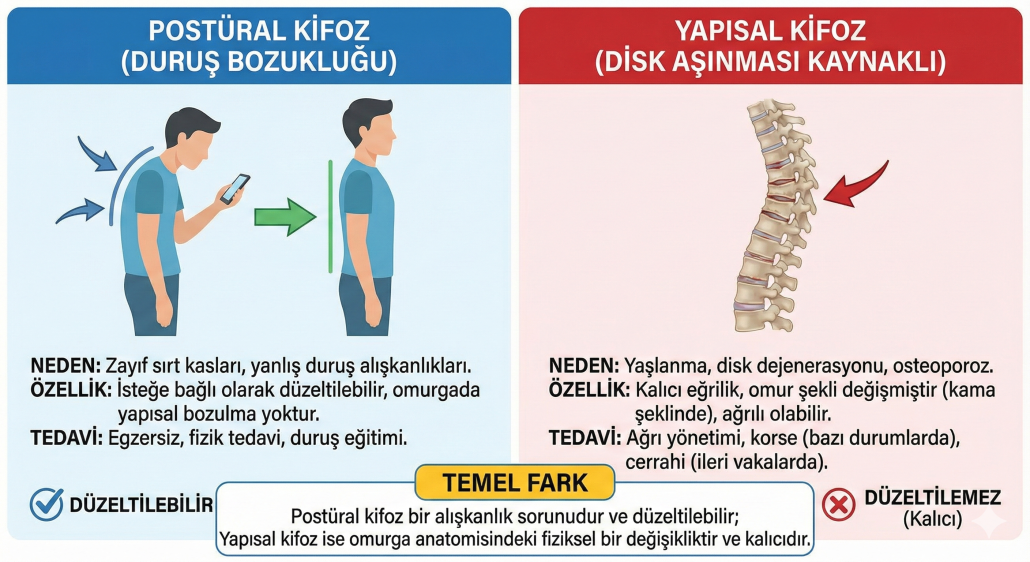
  • Functional Postural Disorders: It is usually due to muscle weakness, habits or psychological factors. When alerted, the child can straighten their spine.
  • Structural Scoliosis: It is a condition where the spine bends more than 10 degrees to the side and simultaneously rotates around its own axis. This is an anatomical deformity and cannot be corrected by the child's voluntary movement.

Scoliosis may appear to be a simple posture disorder when viewed from the outside; however, the underlying rotational movement causes asymmetries in the rib cage and back.

The 5 Key Physical Symptoms of Scoliosis

The type we refer to as Adolescent Idiopathic Scoliosis (AIS), which occurs between the ages of 10 and 18, is generally painless. Therefore, monitoring physical findings is of vital importance. The key asymmetries parents should look out for when observing their children are as follows:

  1. Shoulder Level Difference: When the child looks across, one shoulder is positioned higher than the other.
  2. Scapula (Shoulder Blade) Prominence: When viewed from behind, one shoulder blade protruding or being more prominent than the other.
  3. Waist Curve Asymmetry: When the arms are relaxed at the sides of the body, the distance between the arm and the waist (waist triangle) is not equal on the right and left sides.
  4. Pelvic (Pelvic Bone) Imbalance: The appearance of the hip being shifted to one side or the feeling of unequal leg lengths (false shortness).
  5. Body Shift: The head not being directly above the centre of the pelvis, the torso leaning to the right or left.

Scoliosis Home Screening Method: Adam's Forward Bend Test

The Adam's Forward Bend Test, which we routinely perform during clinical examinations, can be used by families as a preliminary screening method at home.

Application: The child's feet are together, knees bent and legs stretched out in front. Arms are left hanging freely down. Evaluation: The parent should look at the child's back surface from behind. If a height or bump (rib hump) is noticed on one side of the spine (usually on the right back or left waist area) compared to the other side, this is a strong indicator of spinal rotation.

This finding, while not a definitive diagnosis, is the most important indicator that a spinal surgeon should be consulted for further examination and X-ray imaging.

Why is Early Diagnosis Important in Scoliosis?

The decisive factors in the treatment of scoliosis are the degree of curvature (Cobb angle) and the child's remaining growth potential (Risser stage). In a child whose growth plates are still open, low-grade curvatures can be controlled with brace treatment and specific exercises. However, in cases that are detected late and have progressed (over 45-50 degrees), surgical intervention may be necessary.

Scientific data indicates that conservative (non-surgical) methods have a higher success rate in cases of scoliosis detected at an early stage. Therefore, if any of the physical symptoms mentioned above are suspected, seeking expert advice is the most appropriate approach rather than adopting a "it will improve over time" attitude.


Frequently Asked Questions (FAQ)

Does scoliosis cause pain? Scoliosis during adolescence is largely painless. This can lead to the insidious progression of the disease. Pain is more commonly seen in degenerative scoliosis in adulthood or in cases of severe curvature. The absence of pain does not mean that scoliosis is not present.

Does carrying a heavy school bag cause scoliosis? In current medical literature, there is no evidence that carrying heavy bags directly causes structural scoliosis (curvature of the spine). However, heavy loads can lead to postural disorders and back pain. For spinal health, the weight of the bag should not exceed 10-15% of body weight.

Can children diagnosed with scoliosis participate in sports? Yes, people with scoliosis are encouraged to lead an active lifestyle. Swimming and exercises that strengthen the spinal muscles are beneficial for overall fitness. However, for professional-level sports and activities appropriate to the degree of curvature, you must consult your doctor.

Okul Çağı Çocuklarında Duruş Bozukluğu

Kış aylarının gelmesi ve okul temposunun yoğunlaşmasıyla birlikte, çocukların masa başında geçirdikleri süre artmakta, fiziksel aktiviteler ise azalmaktadır. Bu dönemde ebeveynlerin en sık gözlemlediği durumlardan biri, çocukların çalışma masasında, tablet başında veya yürürken sergiledikleri “kötü duruş” pozisyonlarıdır.

Ancak tıbbi literatürde, ebeveynlerin “duruş bozukluğu” (postüral bozukluk) olarak adlandırdığı durum ile kalıcı bir omurga deformitesi olan “Skolyoz” (omurga eğriliği) birbirinden tamamen farklı tablolardır. Bu yazıda, okul çağı çocuklarında omurga sağlığını tehdit eden faktörleri ve masum bir duruş bozukluğunun yapısal bir sorundan nasıl ayırt edilebileceğini ele alacağız.

Duruş Bozukluğu (Postüral Kifoz) Nedir?

Halk arasında “kamburluk” olarak da bilinen ve özellikle ergenlik dönemindeki çocuklarda sıkça rastlanan öne doğru eğilme durumu, çoğu zaman omurganın yapısal bir bozukluğu değil, “postüral” yani duruş kaynaklı bir sorundur.

Postüral bozukluklarda, çocuğun omurgasında kalıcı bir kemik deformitesi bulunmaz. Genellikle zayıf sırt kasları, yanlış oturma alışkanlıkları, teknolojik cihazların aşırı kullanımı ve psikolojik faktörler (içe kapanıklık, boyun hızlı uzaması sonucu saklanma isteği) etkili olur.

Ayırt Edici Özellik: Çocuğa “dik dur” komutu verildiğinde, çocuk omurgasını tamamen düzeltebiliyor ve dik bir pozisyon alabiliyorsa, bu durum genellikle postüral (alışkanlığa bağlı) bir sorundur.

Okul çağı çocuklarında duruş bozukluğu

Yapısal Skolyoz ve Belirtileri

Skolyoz ise omurganın sağa veya sola doğru eğilmesi ve aynı zamanda kendi ekseni etrafında dönmesiyle karakterize, üç boyutlu ve yapısal bir bozukluktur. Duruş bozukluğunun aksine, skolyozda çocuk istese de omurgasını tamamen düzeltemez.

Özellikle büyüme çağındaki çocuklarda (10-15 yaş aralığı) görülen Adolesan İdiyopatik Skolyoz, başlangıçta ağrı yapmadığı için sessizce ilerleyebilir. Bu nedenle ebeveyn gözlemi hayati önem taşır.

Okul çağı çocuklarında duruş bozukluğu için Dikkat Edilmesi Gereken “Kırmızı Bayrak” Bulguları:

  • Shoulder Asymmetry: Bir omzun diğerinden daha yukarıda durması.
  • Bel Kıvrımı Farklılığı: Belin bir tarafındaki kavisin diğer tarafa göre daha düz veya çukur olması.
  • Scapular Process: Sırttan bakıldığında bir kürek kemiğinin diğerine göre daha dışarıda veya yukarıda görünmesi.
  • Body Shift: Çocuğun gövdesinin leğen kemiğine göre sağa veya sola kaymış gibi durması.

Okul Döneminde Omurgayı Zorlayan Çevresel Faktörler-Okul Çağı Çocuklarında Duruş Bozukluğu

Çocuğun genetik yapısında bir hastalık olmasa bile, çevresel faktörler kas iskelet sistemi ağrılarına ve duruş bozukluklarına zemin hazırlayabilir.

1. Ağır Okul Çantaları: Yapılan biyomekanik çalışmalar, bir okul çantasının ağırlığının çocuğun vücut ağırlığının %10-15’ini geçmemesi gerektiğini göstermektedir. Tek omuzda taşınan ağır çantalar, vücudun denge merkezini bozarak omurgayı yana doğru eğilmeye zorlar. Bu durum skolyaza neden olmasa da, ciddi kas spazmlarına ve asimetrik duruşa yol açabilir.

2. Masa ve Sandalye Ergonomisi: Evde ders çalışılan alanın çocuğun boyuna uygun olmaması, ayakların yere tam basmaması veya ekranın göz hizasında olmaması, omurganın doğal “S” kıvrımını bozarak boyun düzleşmesi ve sırt ağrılarını tetikler.

3. “Text Neck” (Teknoloji Boynu) Sendromu: Akıllı telefon veya tablet kullanırken başın sürekli öne eğik tutulması, boyun omurlarına binen yükü 5-6 katına kadar çıkarabilir. Bu durum, gelişim çağındaki çocuklarda erken dönemde boyun fıtığı zeminini ve duruş bozukluklarını oluşturabilir.

Okul çağı çocuklarında duruş bozukluğu için Ne Zaman Bir Uzmana Başvurulmalı?

Erken teşhis, omurga deformitelerinin ilerlemesini durdurmak veya kontrol altına almak için en kritik faktördür.

  • Çocuğun kıyafetleri üzerinde sürekli bir asimetri fark ediliyorsa (bir paçanın daha uzun gelmesi, yakanın kayması),
  • Öne eğildiğinde sırtın bir tarafında hörgüç benzeri bir tümseklik oluşuyorsa (Adam’s Testi),
  • Sık sık sırt ve bel ağrısı şikayeti varsa,
  • Ailede (anne, baba veya kardeşlerde) bilinen bir skolyoz öyküsü varsa,

Vakit kaybetmeden bir omurga cerrahisi veya ortopedi uzmanına başvurulması ve gerekli radyolojik görüntülemelerin yapılması önerilmektedir. Unutulmamalıdır ki; büyüme çağında yakalanan eğrilikler, cerrahi dışı yöntemlerle veya basit takiplerle kontrol altına alınabilirken, geç kalınan vakalarda tedavi süreci karmaşıklaşmaktadır.


Frequently Asked Questions (FAQ)

1. Ağır çanta taşımak çocukta kalıcı skolyoz yapar mı? Tıbbi literatüre göre ağır çanta taşımak doğrudan yapısal skolyaza (kemik eğriliğine) neden olmaz. Skolyoz daha çok genetik ve yapısal nedenlerle oluşur. Ancak ağır ve yanlış çanta kullanımı, duruş bozukluklarına (postüral bozukluk), kas ağrılarına ve geçici omurga eğriliklerine yol açabilir.

2. Yüzme sporu skolyozu tamamen düzeltir mi? Yüzme, sırt kaslarını güçlendirdiği ve omurgaya binen yerçekimi yükünü azalttığı için omurga sağlığı açısından en yararlı sporlardan biridir. Duruş bozukluklarını düzeltmede çok etkilidir. Ancak yapısal ve ilerlemiş bir skolyoz eğriliğini tek başına tamamen düzeltmesi beklenemez; tedaviye destekleyici bir aktivite olarak önerilir.

3. Skolyoz her zaman ağrı yapar mı? Hayır, özellikle çocukluk ve ergenlik çağında görülen skolyoz vakalarının büyük bir kısmı ağrısız seyreder. Bu durum hastalığın sinsi ilerlemesine neden olabilir. Ağrı genellikle erişkin dönemde veya eğrilik çok ilerlediğinde ortaya çıkar. Bu yüzden ağrı olmasa bile fiziksel asimetriler dikkate alınmalıdır.

4. Duruş bozukluğu korse ile düzelir mi? Piyasada satılan hazır “duruş korseleri”, kasları tembelleştirebileceği için uzman hekim önerisi olmadan kullanılmamalıdır. Postüral (duruş) bozukluklarında öncelikli tedavi egzersiz ve ergonomik düzenlemelerdir. Medikal korseler ise sadece yapısal skolyoz tanısı alan hastalarda, doktorun belirlediği ölçü ve sürelerde kullanılır.